Sherry Wood
Jump to the free product comparison template ↓
Quick start: Choose two products that solve the same problem. Compare both on the same criteria, record where you verified each claim, and say who should choose each option. Use the table below to keep the comparison fair.
A product comparison article should help someone make a decision they were already trying to make. The work begins with understanding that decision, choosing suitable alternatives and checking the same important details for each. A long table is useful only when its rows reflect the reader’s real needs.
The strongest conclusion may be different for different people. One option might suit a beginner who wants support, while another suits someone who already has a working setup. Your job is to explain those conditions clearly enough that the reader can recognize their own situation.
Affiliate disclosure: I may earn a commission if you join a paid plan through my links, at no extra cost to you. DIY Websites HQ is independently operated.
Copy this product comparison template
Start with the decision your reader is making. Fill in both columns using the same criteria, and note where you verified each fact. Leave a cell marked “Not verified” if the evidence is missing.
| What matters | Product A | Product B | Source and date checked |
|---|---|---|---|
| Must-have requirement | Does it meet the requirement? | Does it meet the requirement? | Spec sheet or measured test |
| Total cost | Price plus required extras | Price plus required extras | Checkout or quoted price |
| Main trade-off | What will the reader give up? | What will the reader give up? | Documentation or your own observations |
| Best fit | Who should choose it, and why? | Who should choose it, and why? | Your judgment based on the evidence above |
Worked example (illustrative): If a craft cupboard is 12 inches deep, a 10-inch bin fits and a 14-inch bin does not. The larger bin could hold more supplies, but that benefit cannot overcome the shelf-depth requirement. Show the measured shelf and each product’s stated outside dimensions so a reader can check the recommendation.
In this guide
See the method applied to a real decision. My comparison of Wealthy Affiliate, Hostinger, Namecheap and WordPress.com uses the same questions for each option: what is due up front, what renews, what the service includes, and what it takes to move later.
Define the comparison in one sentence
Write a sentence that names the reader, the job and the options. For example: “This page compares two hypothetical storage systems for someone organizing a shallow craft cupboard.” That scope tells you which measurements matter and which impressive-looking features may be irrelevant.
Choose alternatives the reader could reasonably consider for the same job. Comparing an entry-level product with a very different professional system can be useful, but only if the article explains why both belong in the decision. Otherwise, the result may be obvious before the research begins.
Keep the title close to the question. A direct comparison of two named tools should not become a general essay about starting a business. Link to the broader affiliate marketing basics when readers need that background, and keep this page focused on choosing between the options.
Choose criteria before choosing a winner
List the conditions that would make an option suitable or unsuitable. For physical products, that may include dimensions, materials, replacement parts and the job being performed. For services, it may include plan limits, required integrations, billing terms and the work the customer must still do.
Separate essential requirements from preferences. If a product cannot fit the available space, a lower price may not rescue it. A preference such as color can matter to the reader, but it should not hide a compatibility problem. Start with the conditions that can actually rule an option out.
Our affiliate review guide covers the evidence behind an individual assessment. Apply the same honesty here: identify what you used personally and what was checked through documents. Do not imply that both alternatives received identical hands-on testing if they did not.
Make priorities visible without inventing precision
You can use a simple priority framework to organize research. The example below assigns weights to four broad concerns. It is an editorial planning exercise, not a result from a survey and not a claim that every beginner values the same things.
Illustrative editorial weights totaling 100%. These are not product scores or survey findings; change them to match the reader’s actual needs.
- Fit and compatibility35%
- Ease of use25%
- Total cost25%
- Support15%
Scale: 0–100 percent. Values are shown beside each label.
For someone with an existing system, compatibility might deserve even more attention. For someone buying a tool for occasional use, total cost may dominate. Discuss those differences before turning criteria into a numeric score. Numbers can make an arbitrary opinion look more scientific than it is.
If you publish scores, explain their basis, scale and calculation. Apply the same method to every option. A plain conclusion with transparent reasoning is often better than a score such as 9.7 that cannot be traced to meaningful measurements.
Build a source sheet for each option
Record the exact product, version or plan beside every important fact. Save the official source link and the date checked. Note whether the number is an introductory price, recurring amount, minimum commitment or optional extra. Those labels may change the comparison more than a small difference in features.
Use matching conditions. A monthly plan should not be compared with another provider’s annual equivalent without explaining the upfront payment. A capacity figure should use the same units and meaning. “Unlimited” needs its actual conditions checked rather than being treated as a complete specification.
When a detail cannot be verified, mark it as unresolved. Ask whether the gap prevents a recommendation. Do not fill a table cell with an assumption just to make every row look complete. The reader needs accurate distinctions more than a perfectly symmetrical layout.
Use a table for facts and paragraphs for judgment
Keep the first table short enough to scan. Include the criteria most likely to affect the choice, with a source or explanation nearby. A second, more detailed section can cover the conditions behind those facts. A table should provide orientation rather than replace the entire analysis.
For example, a software table might separate the billing period, included sites, renewal terms and key integrations. The paragraphs below can explain what those details mean for a beginner or an existing business. That keeps a simple number from carrying a conclusion it cannot support alone.
Write “not verified” or “check current terms” where appropriate. Do not use a dash that could mean zero, unavailable or unknown. Good labels prevent a reader from drawing the wrong conclusion from an otherwise tidy chart.
Compare the complete job, not only the advertised feature
Ask what the reader still needs after choosing each option. A low-cost hosting service may require separate decisions about backups, email and training. A bundled platform may include services the reader already owns. The useful comparison is the complete setup for that particular project.
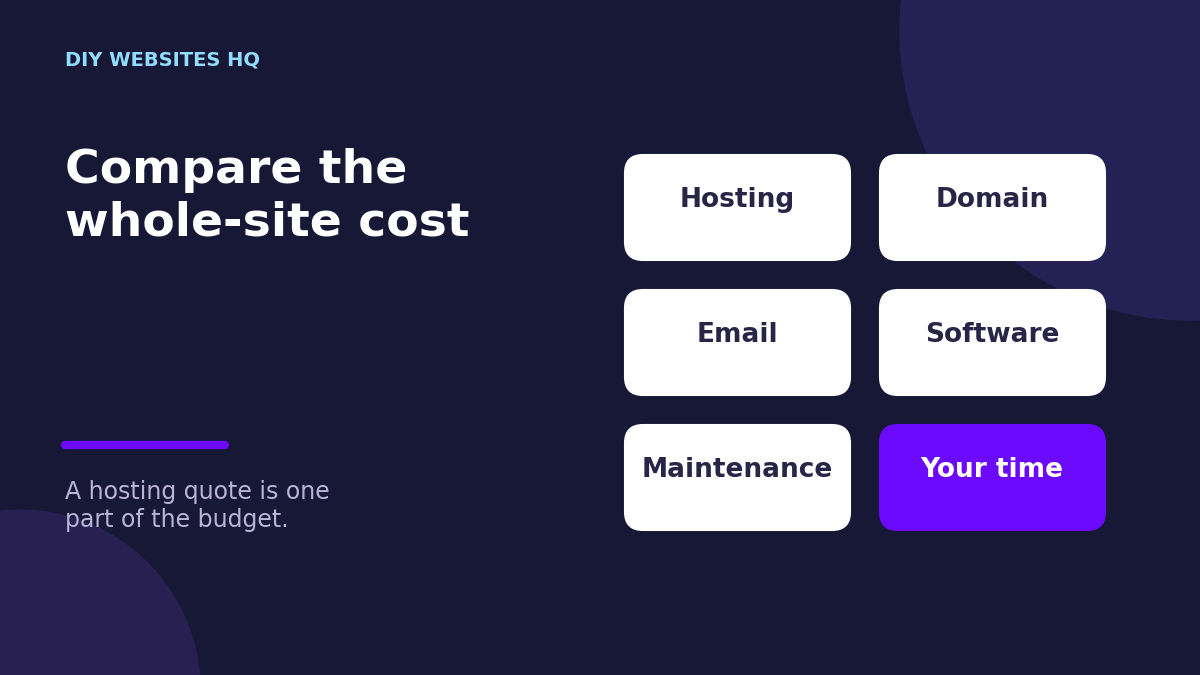
Our website cost guide shows how to list expense categories without pretending every site needs the same budget. Include the owner’s time where it changes the practical decision, but describe time estimates as estimates. Do not assign an hourly value that the reader never agreed to.
Also explain the exit path. Readers may care about exporting content, moving a domain or keeping access after cancellation. Check the current provider documentation for those details. A good first experience and a workable long-term arrangement are related questions, but they are not identical.
Write recommendations for recognizable situations
Use a short decision section with conditional conclusions. “Consider A if…” and “Consider B if…” can be more helpful than a single winner. Give each conclusion a reason tied to the criteria established earlier, and explain the main trade-off the reader would accept.
A third conclusion may be “keep what you already have.” Someone with suitable tools may gain little from switching. Another reader may need to complete a free trial or confirm compatibility before choosing either option. Include those paths when they resolve the actual uncertainty.
Google’s review recommendations support substantive comparisons and meaningful reasons behind a recommendation. Your own analysis should supply the value. Rephrasing two feature lists does not tell the reader how to choose between them.
Add commercial links after the explanation
Make the affiliate relationship visible and label the destination accurately. A reader should know whether the button opens a product page, a plan comparison or a free account signup. Keep the link close to a relevant decision point instead of placing the same sales button after every paragraph.
Preserve the program’s required link format. Check terms before adding redirects, shortening links or using supplied graphics. A comparison can include a non-affiliate alternative when it better fits a reader’s needs; the commission should not decide which options receive fair treatment.
DIY Websites HQ uses WA, and our free Starter guide explains that option. Our platform comparisons also discuss alternatives. The point of a comparison is to make the choice easier to assess, not to hide the conditions that could make a different service appropriate.
For a page you can finish and check, use the one-article content brief to record the reader, decision and evidence before drafting. Then follow the comparison-table readability checklist to check captions, row headings and the phone layout.
Check the page as a decision tool
Read the introduction and conclusion together. Do they answer the same question? Check whether every important table row uses matching conditions. Confirm that screenshots, captions and plan names refer to the version actually assessed. Then test the links and review the page on the public site.
Ask a second reader what they think the recommendation means. If they cannot explain who each option suits, the conclusion may need clearer conditions. If they assume you tested something you only researched, fix the wording before publication.
Plan an update when important terms change. Our older-post maintenance guide explains how to revisit a comparison without changing dates merely to make it look new. A useful comparison remains connected to evidence after its publication day.
Questions about comparison articles
How many products should I include?
Use the number required to answer the decision well. Two carefully evaluated options can be more helpful than ten shallow entries. Add another only when it represents a relevant alternative and you can give it the same meaningful review.
Should the comparison include a price graph?
Only when the prices use comparable conditions and the graph explains something useful. Label billing periods, assumptions and extras. A misleading chart can make an article harder to trust even when the individual prices are technically correct.
What is the first drafting step?
Write the reader’s situation and three requirements before researching a verdict. Those requirements give the comparison a fair foundation and keep the finished article centered on a decision someone can actually make.