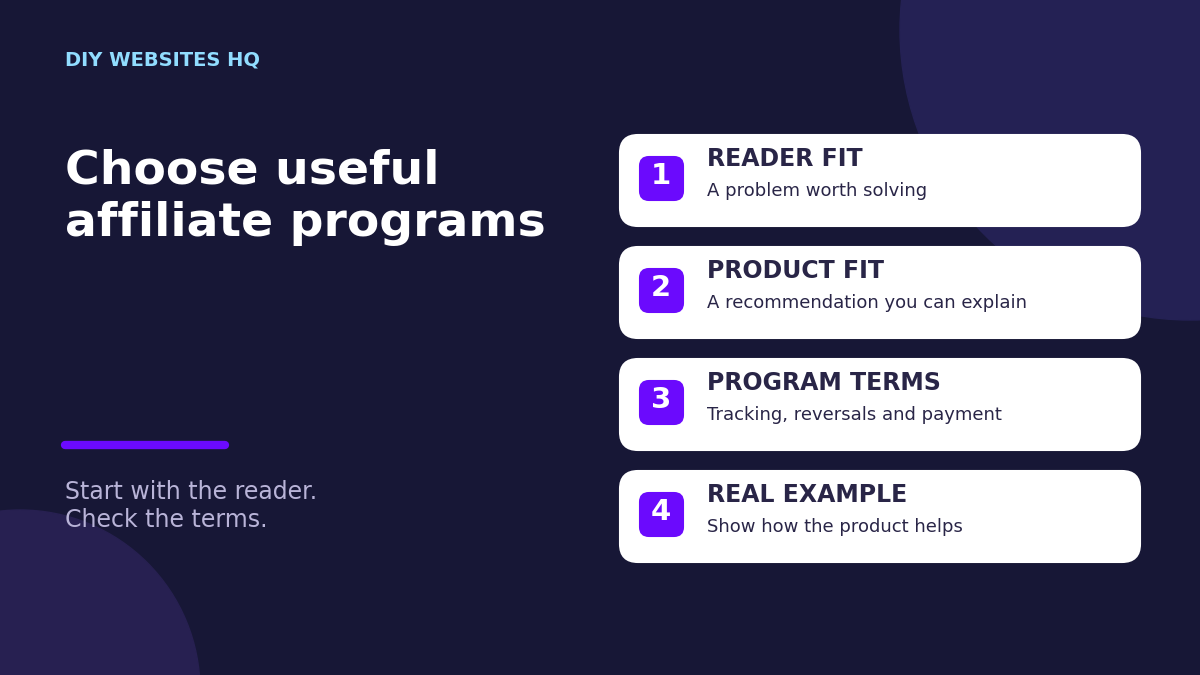
Choose an affiliate program by starting with a reader’s buying decision. A high commission is not useful if the product does not fit the audience or your recommendation cannot be supported.
A recommendation map from DIY Websites HQ
This website’s actual readers need help with several different decisions. A relevant affiliate recommendation should follow the question; it should not replace the answer.
| Reader task | Useful destination on this site | Editorial decision |
|---|---|---|
| Choose a domain | Domain-name guide | Explain the naming decision before a purchase link. |
| Choose hosting or a platform | Comparison section | Explain fit, costs and the alternatives. |
| Find useful article topics | Keyword workflow | Check overlapping tools before recommending another subscription. |
| Publish a first post | Publishing tutorial | Give the useful steps even when no purchase is needed. |
WA is an affiliate relationship used on this site and disclosed near relevant links. That relationship does not mean every website question should end in the same recommendation. Keep a record of the reader problem, why the linked service fits, and the limitation you would want a friend to understand.
Start with the problem, then find the offer
A balcony-gardening site might help a reader choose a suitable container. A website-building guide might help someone compare hosting. A book-focused site might recommend editions or reading accessories. Those are different audiences, so the same affiliate offer does not belong on all three.
Write a short list of products the reader may reasonably need after using your free guidance. Include cases where the right advice is to use an existing item, choose a free option or buy nothing yet. Your explanation should remain useful even if every affiliate link is removed.
Understand the types of program
| Type | Example of the model | What to verify |
|---|---|---|
| Retailer program | A retailer pays for qualifying purchases referred under its rules. | Eligible products, attribution, approved content and commission schedule. |
| Affiliate network | A platform connects publishers with multiple advertisers. | Network approval and each advertiser’s separate acceptance and terms. |
| Direct brand program | A software or product company operates its own referral program. | Product quality, recurring-billing terms, support and tracking. |
| Creator-specific offering | A platform offers a route designed for a particular publishing format. | Geography, eligibility and whether it fits your website or social channel. |
Places to research, without assuming approval
Amazon Associates publishes an operating agreement and program policies. Awin and CJ provide publisher information and advertiser relationships. eBay’s affiliate site distinguishes creator and integration offerings. Read the current route that fits your country and publishing model.
These are research starting points, not a claim that this site belongs to each program or that every beginner will be accepted. Do not copy old commission percentages from a roundup into your budget. Terms, product categories and regional availability change.
Use a program evaluation sheet
- Reader fit: which specific question does the product help answer?
- Evidence: have you used it, examined reliable documentation or compared meaningful alternatives?
- Eligibility: what website, content, location or approval requirements apply?
- Qualifying action: is payment tied to a sale, lead, subscription or another event?
- Attribution: how does the program describe tracking and competing referrals?
- Reversals: what happens with refunds, cancellations or invalid transactions?
- Payment: what are the threshold, timing, currency and payout method?
- Promotion rules: what restrictions apply to email, paid ads, trademarks, images and links?
- Ongoing cost: is participation separate from a product subscription?
Keep a dated link to the official terms. A dashboard screenshot or a creator’s revenue claim does not replace those terms. If a rule is unclear, ask the program before building a promotion around your assumption.
A worked example without made-up earnings
Suppose your article explains choosing a beginner website host. Candidate A has a larger potential commission, but the plan requires a long prepayment that does not fit your reader’s budget. Candidate B pays less but offers the features and payment schedule the reader actually needs.
Your job is to explain that difference. You can recommend B when it is the better fit, show why A may suit a different reader, and include a free or lower-cost route where appropriate. Do not design the verdict around the largest payout.
Write the recommendation carefully
Identify the decision, the criteria and the important limitations. State whether you used the product or are comparing public information. Avoid turning a provider’s testimonial into your own experience. A researched comparison can be valuable when its scope is clear.
Place a plain commission explanation near the link or recommendation. “I may earn a commission if you purchase through this link” is more understandable than a vague label alone. Check the program’s own disclosure wording as well as general endorsement guidance.
Do not confuse revenue with profit
Track approved commissions separately from pending transactions. Record the expenses associated with the website, content and promotion. Refunds and reversals can change the amount ultimately paid. A large order value is not the same as a large commission.
For a new site, early progress may be publishing useful content and learning which questions readers ask. Do not assume an affiliate subscription will pay for itself immediately. Keep expenses within a budget that works without projected commissions.
Maintain your recommendations
Review the destination, availability and relevant terms periodically. Remove or update recommendations when the product changes or no longer fits. If a program ends, a useful article can often remain useful after its links and buying guidance are revised.
Use affiliate marketing basics, the budget and comparison worksheets and the growth plan to connect monetization to a sustainable website.
Further guidance: FTC endorsement FAQs. Program details should be checked directly with the named provider.
Keep building with a focused guide
Once a program fits, prepare recommendations with evidence readers can assess.