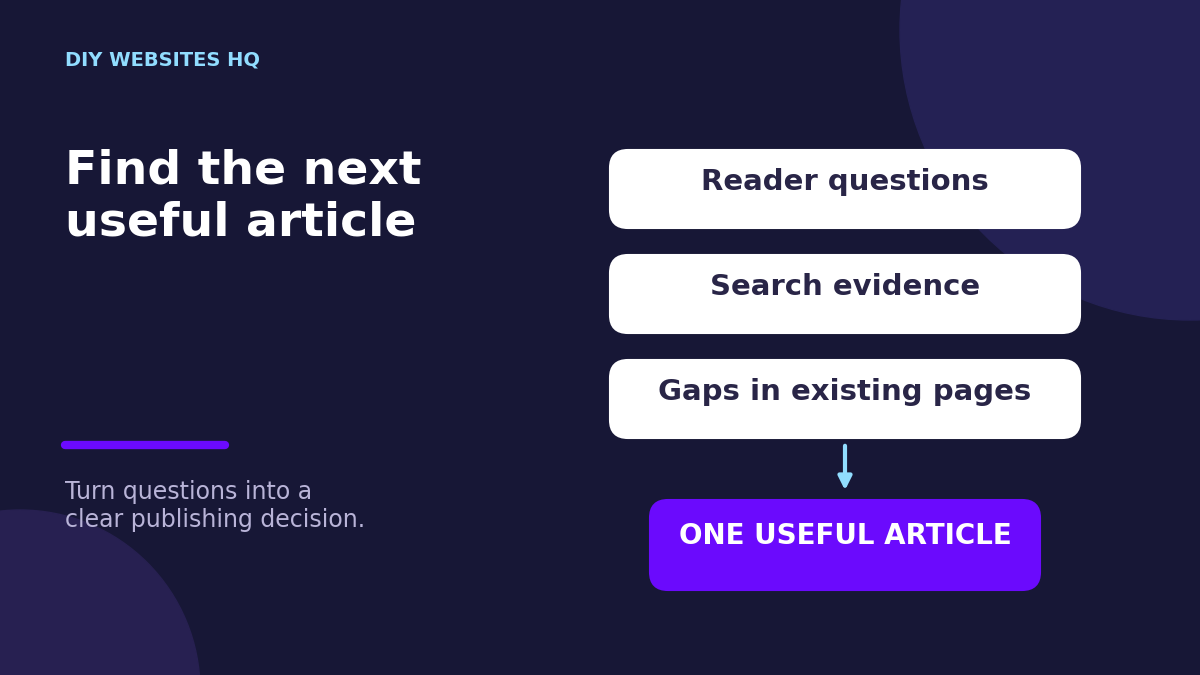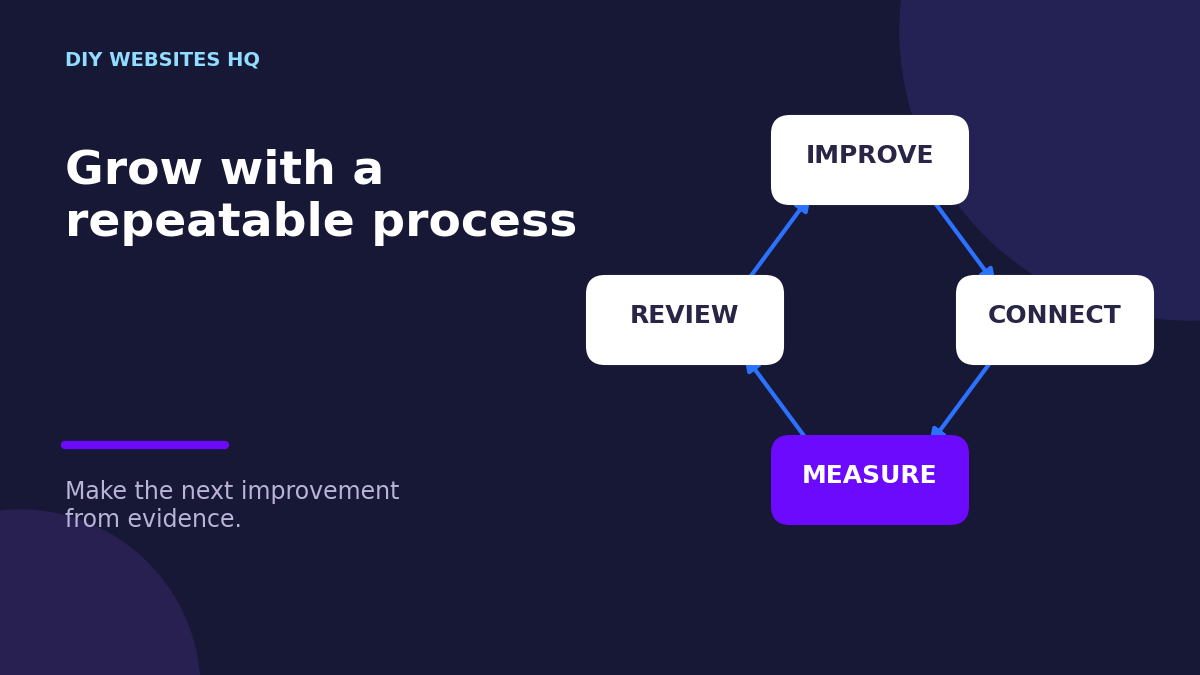
A website grows through a repeatable process: answer useful questions, help people find the answers, measure what happens and improve the weak points. More posts are only valuable when they add something your readers need.
Use a publishing review as the next growth task
DIY Websites HQ’s October 24 review covered 39 public pages and articles. The useful findings were concrete: inconsistent heading spacing, featured-image assignments that had not saved, broken generated thumbnail paths and repeated related-card artwork. Those became a maintenance list before another batch of articles was added.
- Repair the experience: make the existing page, image and next-step link work.
- Connect the answer: link a reader to the relevant comparison, tutorial or worksheet.
- Choose the next measurement: use Search Console’s available indexing and performance data to decide what needs investigation.
A count of repaired pages is a quality-control result, not a traffic increase. Keep the build record separate from later search-performance observations so the next improvement follows actual evidence.
Choose one outcome for the next month
Pick a concrete goal within your control: finish a connected beginner guide, improve a confusing comparison, or create a useful checklist. Avoid a plan made entirely of traffic or income targets that depend on other people’s behavior.
For example, a gardening site could publish a container guide with two supporting explanations and a measuring worksheet. A local service site could improve its service explanation, add genuine project examples and test its enquiry route. The right work follows the audience, not a universal publishing quota.
Build a connected topic cluster
A cluster is a group of pages that answer related questions. Start with the main task, then identify the questions needed to complete it. For a first website, that might include the idea, domain, hosting, essential pages and launch checks.
Link the pages where the next step is relevant. A reader should understand why a link helps. Avoid creating separate thin pages for every slight wording variation of the same question. If two pages serve the same purpose, a stronger combined explanation may be easier to maintain.
Improve existing content deliberately
Review a page for missing steps, outdated facts, unsupported claims, confusing images and broken links. Add a real example or a clearer explanation where it resolves a problem. Updating a date without making a meaningful review does not improve the answer.
Keep a change log with the page, date, problem and revision. If you later see a performance change, that record provides context. It does not prove causation by itself, but it helps you avoid guessing about what changed.
Make distribution useful
Choose a channel where the intended audience already asks questions or looks for ideas. Share a specific helpful takeaway and link when it adds value. Respect the community’s rules and avoid dropping the same promotional message everywhere.
Repurpose the explanation into an appropriate format: a short demonstration, a checklist image or a concise answer. Keep the original meaning and limitations intact. A social preview should accurately describe the destination page rather than promise a result the article cannot deliver.
Build an email list when you have a useful reason
A checklist, a practical planning sheet or a short learning sequence can give readers a reason to return. Explain what they will receive, how often you intend to write and how they can leave. Use a suitable email service and its consent, confirmation and unsubscribe features.
Do not collect addresses merely to create a bigger number. First plan several genuinely useful messages. A simple sequence might help the reader define a project, choose one next task and complete a launch review. Make sure the site’s privacy information reflects the tools and data collection actually in use.
DIY Websites HQ currently provides its worksheets without requiring an email address. An email signup should only be added after the delivery process and privacy details are ready; this article is guidance, not a claim that a newsletter is already operating here.
Measure the right signals
| Question | Evidence to inspect | Possible action |
|---|---|---|
| Can people find the page? | Search Console queries, impressions and indexing information. | Check relevance, discovery and technical issues. |
| Does the page answer the right question? | Actual queries, reader questions and a fresh content review. | Clarify scope or add a missing explanation. |
| Can visitors complete the next step? | Manual testing of forms, links and navigation; suitable analytics if installed. | Fix the specific broken or confusing step. |
| Is the content still accurate? | Current primary sources and a dated review log. | Update prices, policies or product availability. |
| Is the workload sustainable? | Finished work and actual time spent. | Reduce scope or remove unnecessary tools. |
A four-week improvement plan
Week 1: inspect and choose
Review five important pages. Identify the single issue most likely to prevent a useful reader outcome. Check broken links, confusing navigation and missing images before adding more content.
Week 2: strengthen one answer
Improve the selected page with verified facts, an original example or clearer instructions. Add an appropriate supporting link and check the mobile result.
Week 3: help the right readers find it
Share one useful takeaway in a relevant channel and create a related resource if it serves a real purpose. Avoid buying another tool just because distribution feels unfamiliar.
Week 4: review and document
Record the work completed and available evidence. If reports are still processing or the sample is small, say so. Choose the next task based on an observed need rather than reacting to every short-term fluctuation.
What to avoid
- Publishing large batches of generic pages with no distinct purpose.
- Using invented testimonials, results or experience to make a page look established.
- Buying overlapping software before defining the job it will do.
- Changing URLs and navigation repeatedly without a plan.
- Treating an SEO checklist score as a substitute for reader usefulness.
Use the four-week planner and Search Console walkthrough to make the process concrete. Read this site’s build example for a transparent account of implementation decisions.
Search content reference: Google’s people-first content guidance. This plan does not guarantee rankings, traffic or income.
Keep building with a focused guide
Choose a sustainable routine, a useful subscriber path and measurements that explain actual reader activity.