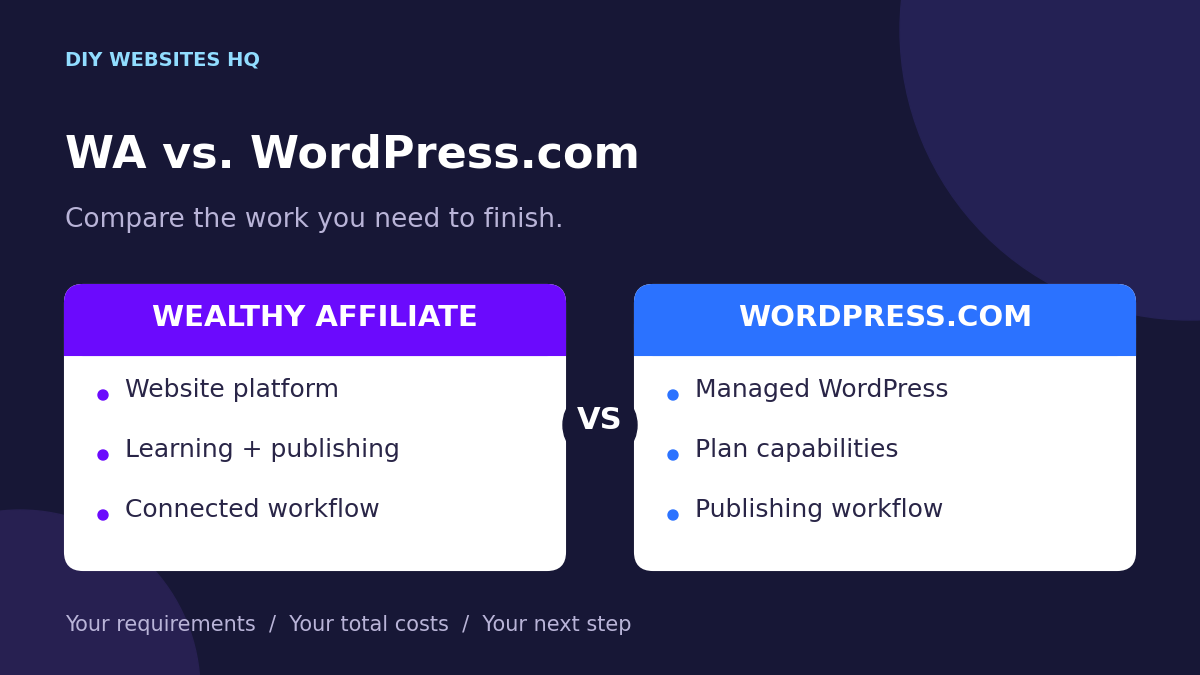
The useful question in Wealthy Affiliate vs. WordPress.com is a hosted WordPress service versus a broader business-building bundle. Choose around the work you need to finish, then compare the full bill and the tasks left to you.
Test a real publishing task, not just the plan names
The working example is DIY Websites HQ itself: one WordPress website with 29 articles, comparison and resource pages, downloadable worksheets and public comments. That is a more useful brief than comparing the largest feature lists a provider can advertise.
This site’s free worksheets use download buttons inside a WordPress page. That gives a specific compatibility check for a possible WordPress.com setup: can the chosen plan and configuration reproduce the needed blocks, plugins or custom HTML, and does the download actually work in a public browser view?
Use one guide as a trial. Check its headings, featured image, internal links, search description and worksheet button. Confirm which parts the selected setup supports and what has to change. A managed platform may be convenient, but a feature that matters to your own workflow should be tested rather than inferred from the WordPress name.
See the actual site-build record and use the platform comparison worksheet to record your own requirements.
What is the actual decision?
Wealthy Affiliate combines hosting with a wider planning, creation, learning and community environment. WordPress.com should be evaluated on the specific product and plan you intend to buy. Comparing brand names without selecting the services can hide important differences.
Write down your next outcome before opening either checkout. A first-time publisher may need help turning an idea into a useful set of pages. An experienced WordPress user may already have a workflow and only need suitable hosting. The same feature list has different value for those readers.
Current cost example
WordPress.com Personal currently displays $4 per month equivalent billed annually ($48 upfront), or $9 with monthly billing, before tax. Check your selected term and its renewal details.
WA’s public Builder plan is $29 monthly or $290 prepaid annually, before applicable tax. Larger plans and usage allowances differ. These examples were checked October 24, 2026 and are not a complete cost quote.
Sources: WordPress.com current product and pricing page and WA public pricing. Account-specific offers and legacy memberships can differ.
| Decision | Current context | Your check |
|---|---|---|
| Plugins | The current public page lists plugin installation on paid plans. | Do not budget around outdated Business-only plugin advice. |
| Storage and domain | Personal lists 6 GB storage; eligible annual plans advertise a first-year domain. | Check storage needs and later domain renewal costs. |
| WordPress distinction | WordPress.com is a hosted service; WordPress.org distributes software. | Confirm that tutorials and integrations match the service you choose. |
Check the specific WordPress.com capability you need
WordPress.com and a self-hosted WordPress installation share a software ecosystem, but service plans and controls are not identical. Make a list of the plugins, integrations, customization and recovery access your project needs. Check the current plan against that list instead of choosing by the WordPress name alone.
Older advice often treats plugin installation as exclusive to a higher WordPress.com tier. The current pricing page lists plugins on paid plans, so that blanket statement is not a sound basis for a new purchase. It still does not mean every plugin is compatible, licensed or appropriate for your site.
A small information site might mainly need readable pages, a contact route and occasional articles. A store, membership or custom application can have very different requirements. Write the visitor journey you need to support, then ask about the particular implementation. A general “can it run WordPress?” question leaves too much unanswered.
Also distinguish the software question from the training question. If you prefer learning from official documentation and already know your publishing process, a hosted WordPress service may be enough. If you want a connected place to develop the project and learn while building, evaluate that broader workflow separately.
Compare first-year cash and renewal separately
Record the amount charged today, the months it covers and the next renewal. A per-month equivalent is not necessarily a monthly payment. Compare the same period, site count and required extras for both candidates.
Add domain renewal, email, backup or restore charges, paid plugins and any external AI subscription your workflow needs. Leave optional purchases out until you can explain the limitation they solve. Use the website budget worksheet to keep the assumptions visible.
Run one complete workflow before committing
Choose a representative task: publish a researched article, build a service page or update an existing guide. Check whether you can edit it confidently, place the required links, review a mobile preview and find help when something is unclear.
For a hosting purchase, inspect the resource limits and recovery process. For a broader membership, test whether the planning and training help you finish. Neither a feature tour nor a generated draft proves that the setup fits your everyday work.
Control, backups and moving later
Know where your domain is registered and where DNS and email are managed. Ask how to export the site, obtain a backup and restore it elsewhere. Do not cancel a working service before the replacement has been tested.
A migration can involve files, database, links, HTTPS and email. Use the backup checklist and domain connection guide to plan those dependencies. Confirm the selected service supports the integrations and access your project needs.
Support: ask a question that reveals scope
Try a concrete question about the exact plan, such as how to restore a damaged site or which tasks are managed for you. Distinguish hosting support from business advice and community discussion. A friendly sales answer is useful, but it is not evidence of independently measured uptime or response speed.
This comparison does not invent speed-test scores or claim that one brand is always faster. A meaningful performance comparison requires comparable configurations, locations and measurement conditions.
Who should choose which route?
Consider WA when the connected business-planning and publishing environment removes a real obstacle and you can afford its recurring cost without assuming immediate revenue. Start with the smallest allowance that fits actual work.
Consider WordPress.com when the selected service meets your website requirements and you are comfortable with the tasks it leaves to you. Keep training and research tools as separate budget decisions if they are not part of that offer.
If you cannot explain the difference that matters for your project, complete a small requirements sheet before paying. Your site purpose, time and budget should lead the choice.
A final decision checklist
- My site and required integrations fit the selected plan.
- I understand the upfront charge and renewal.
- I know the separate domain, email and software costs.
- I can maintain and recover the site.
- I have tested one useful workflow.
- I know when and how I will reassess the subscription.
See the full hosting overview for the wider shortlist, WA plan guide for membership detail, and all comparisons for training and keyword tools.
I may earn a commission if you join through this link.